Showing posts with label Birding Kenya. Show all posts

Tuesday, February 09, 2016

The Kenyan Coast - Watamu and Malindi

I am only a recent convert to the joys of guided birding. There was a time when I regarded this as cheating. Part of the point of birding, surely, is to both find and puzzle out the identification of a bird oneself? Compared to these, the collection per se – adding a bird to your list – is not the most satisfying part of the process, and being shown a bird robs you of both.

But there comes a point when you have to accept your limitations. Taking the individualistic approach is all very well when you’re amongst birds that are familiar and manageable in terms of the number of species. But as soon as you extend it to environments and avifaunas that are unfamiliar, the likely result is frustration and disappointment. This I discovered to my cost in the forests of South America. It’s not that I didn’t see birds, but I was constantly and painfully aware of the scores of species that were passing by me either unseen or unidentified.

My epiphany came in 2014 in Kenya. I was staying on the coast and needed, I thought, someone to show me the places rather than the birds; the famous Arabuko-Sokoke Forest, Mida Creek, the Sabaki Rivermouth etc. At the reception in the hotel where I was staying was a short advertisement for guided birding, accompanied by a photograph of an avuncular-looking man with a professional-looking pair of binoculars. His name was Jonathan Baya and I gave him a ring.

A hot day at the Sabaki Rivermouth. A nice atmospheric shot thanks to my older son, Jovan.
What followed were three of the best days’ birding of my life. This was my last substantive birding in Kenya in 2014 before I left the country, so the 52 species I added to my year list over those three days were more than respectable, especially when you consider that 40 of them were lifers. They included some globally-endangered gems; the Sokoke Scops-Owl (Otus ireneae), for instance, and the Sokoke Pipit (Anthus sokokensis). But the experience was fun too. Our attempt to find Broad-billed Sandpipers (Calidris falcinellus) at the Sabaki Rivermouth had us up to our – well, arses, I suppose is the bon mot – in fine, warm, sticky esturine mud for a couple of hours. It took me almost as long to clean my legs and trousers when I got back to the hotel afterwards.

Jonathan’s skills are manifold. Most guides tend to have an excellent knowledge of bird songs and calls, but Jonathan’s is encyclopaedic and is matched by his ability to mimic. He has patience in abundance, but a sense of realism too. I was disappointed at first when he said we should do two half days of birding each day, with a long break for lunch, rather than keeping at it from dawn until dusk. But, by God, he was right. If we had attempted to bird through the day I would have had sunstroke by 2 p.m. A third factor is that it’s not just the birds, with Jonathan. He started life as a gardener and maintains an avid interest in botany, which makes him a fantastic all-round naturalist. He’s also passionate about the places that we visited, meticulously removing rubbish from the paths as we walked through the forest, for instance. That impressed me enormously. And, finally, there’s a humility that makes birding with him a collegiate enterprise, as it should be, rather than one in which you’re simply shown one thing after another as on a bad safari. There were times when we were puzzling out identifications together, so I was made to feel less like the lost foreigner and more like a partner in a shared experience. I doubt that he really needed my advice, but it was very nice to be asked.

Setting the gold standard for bird guiding, and always with a smile. Jonathan Baya at the Sabaki Rivermouth.
So, for me, it was a no brainer that returning to the coast for a long weekend with my family over my son’s half-term, I would call Jonathan again. For a start, we had unfinished business. Although we had had an excellent half day there, despite the mud, we had failed to find the Broad-billed Sandpiper at the Sabaki Rivermouth last time I was here. And as for the Arabuko-Sokoke Forest the elusive Clarke’s Weaver (Ploceus golandi) had indeed eluded me.

Since this time I was here with my family, I limited myself to two mornings of birding. On the first we made a quick circuit through the lower parts of the forest before moving on to Mida Creek for a scan of the mudflats.

The forest is a remnant of larger woodlands that must have been much more extensive on the coast in the past. In this respect it’s similar as a refuge to some of the Atlantic Rainforest reserves in Brazil. We’d had two mornings and an afternoon here last time I was here, and had seen many of its specialities, but I remember being frustrated at hearing an East Coast Akalat without seeing one. Alas, the same experience was repeated this time. And as for the hoped-for Clarke’s Weavers, these too I missed, as I suspected I would. It was simply the wrong time of year as they move out of the forest in the dry season.

But there were still surprises. We had excellent views of a compact Pallid Honeyguide (Indicator meliphilus), of gorgeous White-throated Bee-eaters (Merops albicollis) and of the forest’s iconic mammal – the Golden-rumped Elephant-shrew (Rhynchocyon chrysopygus). The bee-eaters were followed, though, by a surprise cameo appearance of another speciality mammal of the forest; the critically-endangered Aders’ Duiker is an animal of uncertain specific affiliation, but treated by Jonathan Kingdon in his Field Guide to African Mammals as a subspecies of Harvey’s Duiker (Cephalophus harveyi). Forest birding is difficult, even in Jonathan’s company and his unrivalled knowledge of songs and calls to help you along, so although we saw a couple of mixed feeding flocks, dominated by Chestnut-fronted Helmet-shrikes (Prionops scopifrons), the other lifers I saw were glimpsed only – an adult male Blue-mantled Crested-flycatcher (Trochocercus cyanomelas) and a Red-tailed Ant-thrush (Neocossyphus rufus).

The Brachystegia woodland within the Arabuko-Sokoke forest, doing a reaasonable impression of a European Beech-forest in the Spring

At Mida Creek the tide was at its lowest ebb, and the sun at its highest zenith. Most of the birds were distant and obscured by a miasmic heat-haze. I wasn't about to walk out into that. Luckily, even through this haze the hundreds of Crab Plovers (Dromas ardeola) were unmistakable, but most of the other waders went unidentified and I was forced to accept missing the Dimorphic Egrets (Egretta garzetta dimorpha) that I've seen here before.

The following morning took us to the scene of our mud-bath of 2014; the Sabaki Rivermouth north of Malindi. This time after a brief discussion we decided to avoid the straight march – or rather wade – across the mudflats and instead skirted around to follow the beach, accompanied by an inevitable group of curious local children, who listened intently and obediently to Jonathan’s instruction never to get ahead of us.

At the Sabaki Rivermouth, with entourage.
The beach and mudflats were, of course, awash with waders; Curlew Sandpipers (Calidris ferruginea) were the most numerous, followed by Little Stint (Calidris minuta), Lesser Sandplover (Charadrius mongolus), Greater Sandplover (Charadrius leschenaultii) and Ringed Plover (Charadrius hiaticula). There were plenty of Terek Sandpipers (Xenus cinereus) too, once we'd rounded the point, and then a smattering of Whimbrels (Numenius phaeopus), Curlews (Numenius arquata), Greenshanks (Tringa nebularia), Common Sandpipers (Actitis hypoleucos), Wood Sandpipers (Tringa glareola) and Marsh Sandpipers (Tringa stagnatilis). Last time I came here we did not see White-fronted Plovers (Charadrius marginatus) at the rivermouth, but on this occasion there were at least a few tens of them.

Terns and Gulls were also resting on the mud in mixed flocks. The most numerous were Caspian Terns (Hydroprogne caspia) and Saunders’ Terns (Sternula saundersi), followed, in order, by Great Crested Terns (Thalasseus bergii), Heuglin’s Gulls (Larus argentatus heuglini), Sooty Gulls (Larus hemprichii), Lesser Crested Terns (Thalasseus bengalensis) and, the first surprise of the day, at least three Slender-billed Gulls (Larus genei), two of which were already showing the pink wash beneath. These last were lifers for me and genuinely unexpected.

A young Saunders' Tern at the Sabaki Rivermouth

But after searching en masse, it was time to start searching in detail, going through the Curlew Sandpipers one by one in search of our Broad-billed Sandpiper. We thought we’d found him for a while, until the bird took off and showed its white rump, which sent us back to the drawing board. Eventually, though, next to two Ringed Plovers, we found our bird. It was distant, but clearly the Broad-billed Sandpiper we were looking for. It was moulting into breeding plumage and gaining large spots on its breast, which was a clear indicator that it was not a Curlew Sandpiper. The back was a mixture of greyish feathers, and darker ones with white edging. The bill was, indeed, broad-looking but the giveaway was a very clear white spot in front of the eye which swept back behind as a standard supercilium, but also seemed to sweep upwards towards the crown, losing distinction above and beyond the eye. I would dearly love to have seen this bird closer-to, but I wasn’t going to wade out into the mud after my last experience, so this will have to do, for now, for this supremely elusive species.

Walking back across the scrubby dunes we were blessed with a stunning Northern Carmine Bee-eater (Merops nubicus) – only my second after one in Mogadishu in 2014 – and the year’s first Yellow Wagtails (Motacilla flava) of two different subspecies – a lutea and a beema.

A distant Northern Carmine Bee-eater, but even in this photo the vibrant colours are obvious

So, yet again, a wonderful couple of days. Tourism on the coast of Kenya is suffering because of fears of insecurity, but for birding this place is a must. You’re highly unlikely to see any of its key speciality birds – the Scops-owl, and the two local pipits, Sokoke and Malindi (Anthus melindae) – anywhere else, at least in the same place, and over a few days Jonathan can show you several wildly differing environments with wildly differing birds and at an extraordinarily reasonable price.  I’ve said it repeatedly in this Blog, but without visitors injecting money into the local economy on the basis of habitat preservation, communities will have little incentive or ability to resist the constant pressures for alternative, and inevitably destructive, forms or development.

Malindi Pipit at the "Swamp" in the Arabuko-Sokoke Forest. A tricky bird, like all pipits, but the streaking on the flanks is diagnostic. You'll have to magnify in order to see this.

And as for Jonathan, well I cannot recommend him highly enough. It’s not just because he was the first person to take me birding professionally, but for me the way he does it marks the gold standard of bird guiding. So if you go to the Kenyan coast, and go you should, then contact him. You will not regret it. He can be reached at jonathanbayakarisa@yahoo.com or through a website facilitated for him by T.R.A.C.K Tours in the UK. He also specialises in tours of both Tsavo National Parks and to the Taita Hills.

Until next time. Jonathan at "John Fanshawe's Roundabout" in the Arabuko-Sokoke forest, where Fanshawe carried out his research on breeding Clarke's Weavers.

Wednesday, February 03, 2016

Nairobi National Park

The political scientist and historian Timothy Garton Ash once memorably described all British foreign policy since 1945 as "footnotes to Churchill". For me, all my birding in East Africa has been footnotes to Nairobi National Park.

A Long-crested Eagle (Lophaetus occipitalis) in Nairobi National Park last Saturday. 
It was here, back in 2000, that I had my first ever experience of African birding. I was taking a group of British MPs around Central Africa - Rwanda, Burundi, DRC - and like most people we had routed ourselves through Nairobi because that's where all the NGOs are headquartered for their operations in this part of the world (this was all before I joined the dark side and became a diplomat). I was blown away. Even without my binoculars, and with only the antediluvian Ber van Perlo guide to the Birds of East Africa to show me the way, I still came away having seen several tens of species in a matter of hours.

But that was nothing. The legendary Brian Finch, who has published a checklist to the birds of the Park, regularly reports seeing between 180 and 200 species of birds in a day. A day! My own best total for the park - and it's the largest number of species I've ever seen in a day, anywhere in the world - was 129. That figure is pretty fresh in my memory, because it happened this Saturday. But when I lived in Kenya I would come to the park every second or third weekend, and it was only on my very last visit before we left the country - and perhaps there's some symbolism here - that I had my first visit without seeing a species that was new to me.

Grey Crowned-cranes (Balearica regulorum), looking like they've just had a tiff
Those pesky Cisticolas - a complex group to tell apart. Ten species occur regularly in the Park, one of the highest species densities I've encountered anywhere. On this visit I saw six of those species. I make this a Stout Cisticola (Cisticola robustus), common in the grassy areas of the park.
There are many things that make this place special. Let's start with the most simplistic; it's on the doorstep of a major international city, right next to that city's two major airports, and yet it is still a place where you can reasonably expect to see three of the "Big Five" African mammals (Lion, Buffalo and both species of Rhinoceros) and have a reasonable chance at a fourth (Leopard). And these are wild animals, some of which regularly migrate in and out of the Park. A Cheetah showed up recently. It wasn't introduced. It walked here. To find this kind of megafaunistic wildness right next to a big city is, almost literally, incredible. Perhaps needless to say, it's also under threat - a subject I'll return to.

Turning to what makes it special for birding, though, the key element of the Park is variety of habitat. Effectively it's divided into three areas; highland forest, long-grass plains, and short-grass plains. These support a different variety of both mammals and birds, but there are further micro-climates around the various dams that have been built throughout the park, and the riparian forest that follows the Mbagathi river. There's more to it than this, of course, but that'll do for the broad-brush introduction.

What can I say about this particular visit? Well, in short, it came up trumps. After my last, melancholic visit in 2013, the place was back on form, or perhaps I was. I visited over two days and saw, in total, 150 species of bird, 17 species of mammal and three identifiable reptile species. Of these, seven of the birds and one each of the mammals and reptiles were new to me. So still, after perhaps 15 or 20 visits, this place continues to launch surprises at me.

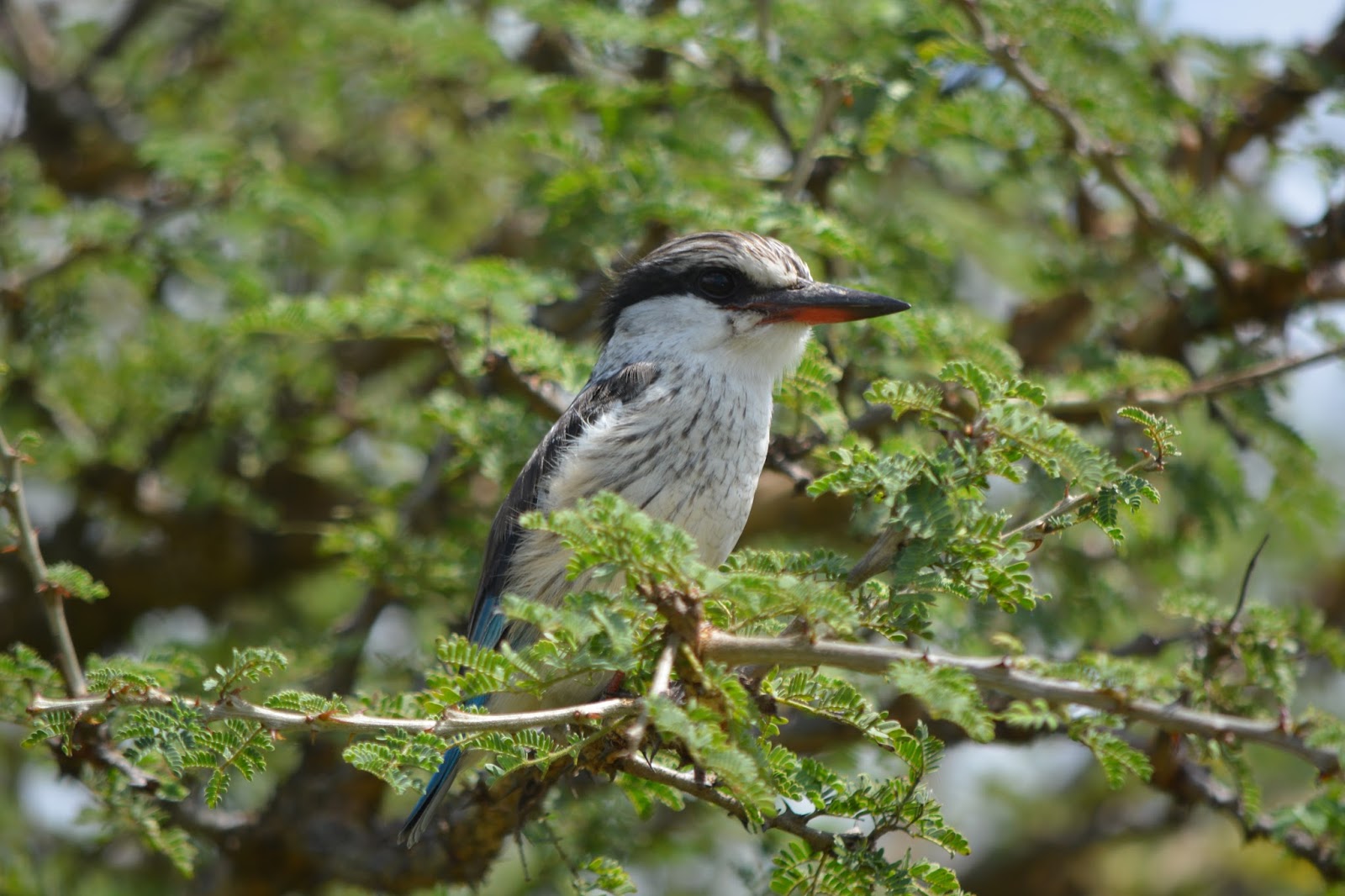
Striped Kingfisher (Halcyon chelicuti)

Female African Paradise-flycatcher (Terpsiphone viridis).
In short, Nairobi National Park is a treasure. It's one of the best and easiest places in Africa to see Common Ostriches (Struthio camelus), which live in high densities here. I had a male Kori Bustard (Ardeotis kori) saunter out in front of me on the road, and watched at least 70 White Storks (Ciconia ciconia) launch themselves northward in a favourable thermal. I saw my first African Emerald Cuckoo (Chrysococcyx cupreus) in a treetop, and jumped for joy in my car at my first African Pygmy Kingfisher (Ispidina picta). I saw a huge African Rock Python (Python sebae) shimmy out of a hole in the road and watched a magnificent Ayres' Hawk-eagle (Hieraaetus ayresii) quartering over the forest. There were Lions (Panthera leo) basking near one of the dams, and a Bush Duiker (Sylvicapra grimmia) creeping through the undergrowth of the forest above. This is still a place (touch wood) where numbers of White-backed Vultures (Gyps africanus) and Ruppell's Vultures (Gyps rueppellii) remain healthy, and where Palearctic migrants like Turkestan Shrikes (Lanius isabellinus phoenicuroides) and Greenshank (Tringa nebularia) can find fuel to come back to us for the summer. And all these were just on this visit. I could go on, and on, and on, but rather than do so I'll let the unusually large number of photos in this post speak for themselves.

My first ever African Pygmy-kingfisher
Another Kingfisher - this time a Juvenile Malachite (Corythornis cristatus), biting off more than it could chew.
A Ruppell's Vulture (R) with two African White-backed Vultures.
Despite all this I have a feeling that people think that birding, or seeing animals here, is cheating, just because it's next to a city. But these creatures are as wild as those you'll see in the Masai Mara or Amboseli. It's not cheating. It's extraordinary. It's almost unbelievable.

And perhaps, soon, it will be unbelievable that it ever existed. Nairobi is expanding, and, thankfully, increasing in prosperity. It needs space, and infrastructure. To those with a certain frame of mind the Park is wasted space - a blank area through which lines can be driven. There has probably never been a time when someone has not had their eye on the Park for one economic reason or another, but the latest threat is serious; there is a proposal to drive a new train-route through the Northern section of the park, right through some of the most important watering sites and with potentially devastating effects on the Park's ecology.

So, come. And pay to come, and make it worth everyone's while to keep this unsurpassed urban birding location in existence, and springing surprises on me and you, into the future. If you don't come, they will build on it.

The ever-photogenic Superb Starling (Lamprotornis superbus)

Looking down towards the Mokoyeti river. Long may it continue to look like this.


Wednesday, March 25, 2015

Nairobi - abundance

I've written before about the abundance if birds that you see in Equatorial Africa. I've been lucky enough to bird in tropical South America as well, but it can't compare with Africa, or at least East Africa. No doubt the overall levels of diversity are the same or greater, but presumably it's the habitat or, I like to think, perhaps, a longer history of cohabitation with humans, but in any case they're certainly easier to see in Africa than South America, in my limited experience.

To give an example, I think my overall list on my first visit to Amazonia was around 120 species. Bear in mind that this was proper rainforest birding, which is not straightforward, and that I was the only birder on the expedition, so I wasn't overwhelmed with help, but, still, it's not a vast figure for three weeks in the "torrid zones" (as they used, charmingly, to be called). By comparison I've seen 110 species in one day in Nairobi National Park, and my year list by this stage last year, which was almost all spent in Kenya, was almost 400 species.

Still, not all locations are created equal, and Nairobi does seen to have some sort of magic. Perhaps it's the altitude; at almost 2000 metres it makes for a near-perfect climate, neither too hot nor too cold, and ideal for spending a whole day in the field. Try that in Amzonia and you'll be exhausted pretty quickly. It's also perhaps the fact that Nairobi spans at least two distinct ecosystems - the open grasslands of the Athi plains, dotted with acacias, to the South, and the highland forest to the North. If you play your cards right, and even if you simply drive from the airport to the centre, you're going to bridge those two ecosystems and see birds from both habitats.

I had a day in Nairobi between my visits to Sudan and Somalia, and another day there after Mog. I spent most of that time in the leafy suburb of Karen, named after Karen Blixen, whose farm was there. How did it measure up?

My friend's hideaway in Karen


Well, I won't go into the usual list of species, partly because I'm on the road and can't be bothered to check their taxonomic names, but I'll add the list later. Suffice to say that having spent 5 days in Sudan, and seen 21 species, within 10 hours of arriving in Nairobi I'd seen 38, and had 45 before I left, and this without any real effort beyond sitting in my friend's garden with a beer.

All the effort I put in. Garden, binoculars and beer.

Amazingly this list included a LIFER - a bird that had eluded me all the time I lived here; a Common Scimitarbill (Rhinopomastus cyanomelas), which made sure I saw it by repeating its loud song so long, so insistently, and so close that I couldn't ignore it. And perhaps even more amazingly it included a species I managed to tick off while basically asleep after the early morning flight from Khartoum - the unmistakable and unmissable sound of a flock of migrating European Bee-eaters (Merops apiaster). Good luck to them. They've a long way to go and according to all the emails I've seen from my old Kenyan birding networks, the migration is very late this year.

Anyway, as I said, Nairobi has a certain magic, which perhaps comes across with my enthusiasm. But I mentioned that I'm on the road again. Where to? Well, the clue's in the photo below - a book I never would have believed in a million years that I would ever need. To my enduring amazement this is a work trip, but I'm taking the time to explore as much as I can while there. I'll post in due course.

Never, ever, thought that I would need this book. Not in a million years.