Showing posts with label birding Khartoum. Show all posts

Wednesday, September 21, 2016

Spring Part 3 - the Belgian coast and the Dutch delta

It's funny what can get you back on a horse after you've fallen off, metaphorically speaking. I haven't written a blog post since April, and it's not for a lack of material. Quite apart from the trip described below, I've had a sensational Spring break in Hungary, a weekend of birding in Uganda, and a family holiday on Mallorca, all with birds to report. And that's to say nothing of a visit to the Masai Mara in January, which I failed to write up at the time.

So, why the absence? The easy answer is busy-ness, and it's true enough. But the real answer is that, both personally and professionally, I've taken a few knocks over the past few months. When that happens you tend to want to share less of yourself, as a loss of confidence in one area leads to a loss of confidence across the board. But, inevitably, along comes a catalyst that shakes you out of your slough, and there's no predicting what it might be.

In my case it was an unexpected and delightful email from a retired former professor of biology in Canberra. I've never met him, nor, alas, do I ever expect to. I've driven through Canberra once, but there is precious little prospect of my returning there, or of David pitching up in Europe, any time soon. But he had read my blog, specifically the one on Sudan, and found it interesting enough to write to me about it. He himself had worked at the university in Khartoum back in the 1960s and in searching for up-to-date information on the natural history of the city and its surroundings, had stumbled upon my ramblings.

The specifics of his message matter less now than the shattering revelation that anyone actually reads this stuff. That is a less idiotic statement than it sounds. Of course I write a public blog. But I do so semi-anonymously, irregularly and on a relatively esoteric subject. And I've no idea whether or how to advertise what I do write. Under these circumstances having any audience at all is not to be taken for granted. The internet is, after all, a vast, virtual graveyard of unread material written by people who hoped it would project their voice to the world. So, as I wrote to David, receiving his message inspired me to get back into the saddle and start writing again about my random and marginal meanderings between diplomacy and ornithology. It's for myself, above all, but if it's interesting and pleasurable for others, which, apparently, it is - then so much the better for me.

The logical place to start is where I left off, which was preparing eagerly for that rare event in my life, a birding trip in the company of other birders. I had met Jean in Montenegro and taken contact details which allowed for us to arrange for day's birding at an old favourite of mine, Het Zwin, on the northernmost extremity of the Belgian coast.

A Common Tern (Sterna hirundo) near Nummer Een in the Netherlands in April
I was eager in anticipation, and early in arrival at our rendezvous, but the initial signs were not particularly propitious. It was mid-April but a freezing wind was blowing straight in off the sea, and sensible birds - and people - were hunkered down. Spring being what it is, song was in the air - Nightingales (Luscinia megarhynchos), Blackcaps (Sylvia atricapilla), Chiffchaffs (Phylloscopus collybita) and Willow Warblers (Phylloscopus trochilus) - but these songs were being delivered for the most part from deep cover, and I can't say I blame the songsters. It was chilly.

Jean arrived with two friends, Wulf and Peter, and comradeship is warming in itself. After my usual solitary experiences this was the birding equivalent of a night in the pub with the lads, and in these circumstances even a lacklustre day took on a certain quality. And lacklustre, honestly, it was for the most part. I was shocked at my seeming decrepitude when I was physically unable to hear a Grasshopper Warbler (Locustella naevia) until we were almost on top of it (though we still didn't see it). But apart from that the morning was notable only for a trickle of predictable year ticks, with the most notable being Avocet (Recurvirostra avosetta) and Woodlark (Lullula arborea).

Things picked up a bit at lunchtime when we headed inland a little to a few ponds next to a vast second-world bunker complex in search of Belgium's only breeding Black-crowned Night Herons (Nycticorax nycticorax). We found them too, which given the wind and the cold was perhaps not to be expected. And in addition we stumbled upon a small fall of migrating wagtails - mostly nominate Yellow Wagtails (Motacilla flava), but with a few of the predominantly-British flavissima race. The original Yellow Wagtails, these were, for me - the ones I grew up with around Stodmarsh and Sandwich Bay in Kent.
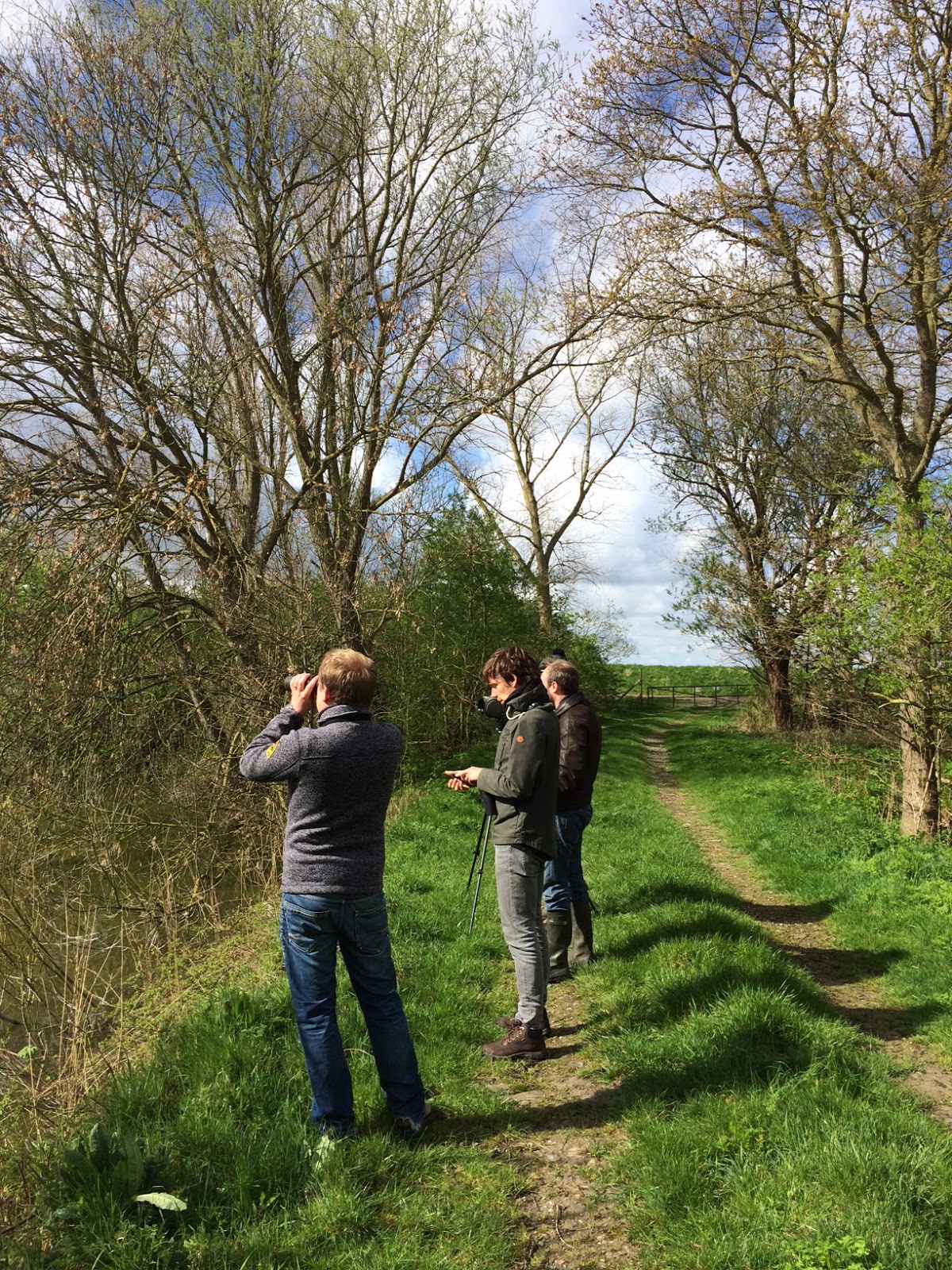
The lads looking at Night Herons near Het Zwin. Note the cold weather gear, even though it's mid April.

Jean and his friends had to head back at lunchtime, after a short and windy visit to the front at Zeebrugge, but with their advice in mind I myself headed up to the beginnings of the Dutch "Delta" between Breskens, which I'd visited before, and the oddly-named "Nummer Een" (literally, "Number One", in Dutch - I've no idea where the name comes from). Here the edge was off the wind and a perfectly-placed hide on top of one of the dykes afforded great views of massed waders and roosting terns and gulls, including surprisingly large numbers of the increasingly inaccurately-named Mediterranean Gull (Larus melanocephalus), looking spick-and-span in their breeding plumage.

The well-appointed and thankfully shower-proof hide at Nummer Een

This whole area along the coast can be fantastic at this time of year - any time between mid-April and the end of May, basically - and if I'd had the time, the sense and the inclination I would have been back over the subsequent couple of weekends to fill in what I missed this time; Bluethroat (Luscinia svecica), for instance, which breeds in good numbers around here. But I didn't, so I missed them, and writing this towards the end of September I can say with some confidence that this is one of a few species that I will certainly now not see this year, as they don't winter in significant numbers in any of the places in Africa that I visit regularly.

I do hope, though, to experience the place in the autumn, for what it has to offer then. And to do so again this coming winter. I made no sorties to the coast at all in the first couple of months of this year, so I missed the mass of grey geese and any chance of Whooper Swans (Cygnus cygnus) and Bewick's Swans (Cygnus columbianus bewickii). That's for the coming period.

Looking across the delta at Nummer Een

Friday, March 20, 2015

Sudan

Khartoum was my first port of call on a quick visit to East Africa betwen 11 and 17 March. This was my first visit to Sudan, but I've been following Tom Jenner's mouth-watering Blog, Birding Sudan, since I started working on the country last summer. Have a look for yourself and you'll see a lip-smacking list of species, united, for the most part, by their affinity to water. Alas, Tom and I missed each other on this occasion, as he was travelling homebound as I arrived. I can't help thinking that my birding suffered grievously as a result.

A dusty day in Khartoum

Khartoum is built on the confluence of two of the world's great rivers, the Blue Nile, rising in Ethiopia, and the White Nile, flowing down from Lake Victoria. Their merger preduces the Nile, sensu strictu, and you'd think that a city built in such propitious geographical circumstances would open its heart to this miraculous surge of water passing through the parched land. But not a bit of it. In fact, travelling around the city between meetings, my only glimpses of water were as we crossed the Blue Nile over high bridges. Those roads that do follow the River do so at some distance, so you can barely catch sight of the glint of reflected light as you zoom (or crawl, depending on the time of day) from place to place. Charmingly, though, the land between these roads and the river is often, for now, given over to agriculture, even close to the city centre, and I'm sure these areas would be well worth exploring on a future visit. In fact I know they would be from reading Tom's blog.

I'd planned to come to Khartoum fully a month before I actually managed to do so, and as a consequence I arrived after the heat had already returned. The days were baking - high 30s and even low 40s Celsius - though it's a dry heat which is a good deal more manageable than the sauna of Mogadishu I experienced afterwards. Nights were cooler and pleasant. Dust blew in on my second day in town, hanging in the air like a mist, and was followed by a steady wind for the last couple of days.

Just in case you couldn't see it first time. It was quite dusty.

Since I was deprived of the river and its banks, the birds I saw in the city were restricted to roadside verges, the small hotel garden, and the sky overhead, and they certainly had an arid flavour to them. The sky brought me Black Kites (Milvus migrans aegyptius), of course, including my first migrant nominate birds of the year (M.m. migrans), plus African Palm Swifts (Cypsiurus parvus), Laughing Doves (Spilopelia senegalensis) and Namaqua Doves (Oena capensis). Roadside verges added Spur-Winged Lapwings (Vanellus spinosus). The hotel garden was honestly a bit of a disappointment; huge numbers of House Sparrows (Passer domesticus), making a din like a forest-load of cicadas in the morning, a Graceful Prinia (Prinia gracilis) or two, some African Mourning Doves (Streptopelia decipiens), a pair of Spur-Winged Lapwings and a few Common Bulbuls (Pycnonotus barbatus). The only real surprise was a goodly number of Blue-naped Mousebirds (Urocolius macrourus) whistling away from the top of a bamboo hedge like a gang of slightly drunken Eurasian Scops-Owls (Otus scops).

A Spur-winged Plover (Vanellus spinosus) and a male House Sparrow (Passer domesticus) hanging out on the hotel terrace.
And so passed my two and a half days in Khartoum. And that would have been it, for a normal business trip, but since I was travelling onward within the region afterwards, and since I have to spend the weekend somewhere, I and a colleague elected to do so in Sudan, and were rewarded with a sneaky trip in the desert North-East of the city for the penultimate night of our stay.

This is scrubby desert, with occasional stretches of stony ground bereft of plant life, but without large expanses of sand. There are numerous small trees and bushes and good expanses of dried grass and other low herbiage, but very few large trees, and, needless to say, almost no open water (except for a single waterhole that we saw beset on all sides by vast flocks of goats). I've had a limited experience of desert birding, and knew that I couldn't expect a cornucopia. Like all life in such marginal habitats, birds are relatively few and far between. Still, even I was shocked by the almost complete lack of any birds at all on the long drive through the scrub after we left the tarmac. I began to think I'd brought my binoculars for nothing but to get the lenses covered in sand.

The desert. More Sahel than Sahara and a bit of a lurid picture.
But as we approached our intended camp site, things began to look up. The first sign was four Chestnut-bellied Sandgrouse (Pterocles exustus),  a LIFER for me, flushed from beneath a bush. Then came the Bar-tailed Larks (Ammomanes cinctura), another LIFER, and then the first of several big flocks of Greater Short-toed Larks (Calandrella brachydactyla), which must have added-up to at least 300 or 400 birds in total. A Great Grey Shrike (Lanius excubitor - or Southern Grey Shrike, Lanius meridionalis, if you prefer - in either case of the "Aucheri" race) was the only predatory bird I saw, but there were large flocks of African Silverbills (Lonchura cantans) in one location, and quite a few Black-crowned Sparrow-larks (Eremopterix nigriceps), again a LIFER, scattered around. All this before we'd stopped the car.

While camp was set up, I took a walk around as the heat faded. I'd already picked-up three LIFERS, and soon added two more; a pair of strutting Greater Hoopoe-Larks (Alaemon alaudipes) and a few skulking Cricket Warblers (Spiloptila clamans), some of which responded to pishing.

Setting up camp. The first, and most essential stage - brewing-up.
Camp consisted of three old portable iron bedsteads with thin mattresses drawn-up in the lee of the parked car, but though we lay and wondered at the stars, we didn't go straight to bed, instead venturing out in the car again to see what a vast halogen lamp could reveal of the nighttime wildlife. The desert floor was full of holes, and it soon became apparent that these were almost all made by Desert Jerboas (Jaculus jaculus), who careered around in front of the car in large numbers like a host of miniature clockwork kangaroos. There were a few Scrub Hares (Lepus saxatilis) around, as well.  But the highlight was a tiny Fennec Fox (Vulpes zerba) which pelted along with its tail flat behind it, not much bigger than the Hares we'd just seen.

The morning of the last day dawned surprisingly slowly, and surprisingly coolly, giving me time for a bit more wandering before the heat set in. Aside from the species of the day before, there were two more to be found; a pair of Lichtenstein's Sandgrouse (Pterocles lichtensteinii) flushed from a tiny depression in the ground, and, my last LIFER for Sudan, two softly-spoken Brown-necked Ravens, (Corvus ruficollis).

Sunset in the desert. Waiting for the Nightjars and Owls that never came.
You can't beat a night in the desert. It's a salve for the soul, and there's something primordial about lying there with nothing between you and the sky. Not that I slept very well. It was windy as hell. But never mind. Those stars and the resounding sound of silence (at least before my colleague started snoring) will stay with me for a while.

Still, from a birding perspective, and despite my six LIFERS, it was, frankly, a rather disappointing trip. I saw only 21 species in my time in Sudan, including the time in Khartoum. I was surprised at the lack of Nightjars, or of Owls, or of any bird of prey, in the desert. We were there for more than 24 hours, so I can't put this absence down to a want of searching. And at least as far as Owls are concerned there was no shortage of prey in the Jerboas. Have they been hunted out, or is this just such a marginal habitat that they're merely very thinly-spread?

I thought that this might be my first and last trip to Sudan, but it seems I will probably be back fairly soon, and next time I would dearly love to spend more time next to, or even just near, the river. And I'll certainly make more of an effort to ensure that when I go I can meet up with Tom Jenner, if he's free and keen. This is not a country in which you can wander around with binoculars hoping for the best. That lesson has definitely been learned.