Showing posts with label birding het zwin. Show all posts

Wednesday, September 21, 2016

Spring Part 3 - the Belgian coast and the Dutch delta

It's funny what can get you back on a horse after you've fallen off, metaphorically speaking. I haven't written a blog post since April, and it's not for a lack of material. Quite apart from the trip described below, I've had a sensational Spring break in Hungary, a weekend of birding in Uganda, and a family holiday on Mallorca, all with birds to report. And that's to say nothing of a visit to the Masai Mara in January, which I failed to write up at the time.

So, why the absence? The easy answer is busy-ness, and it's true enough. But the real answer is that, both personally and professionally, I've taken a few knocks over the past few months. When that happens you tend to want to share less of yourself, as a loss of confidence in one area leads to a loss of confidence across the board. But, inevitably, along comes a catalyst that shakes you out of your slough, and there's no predicting what it might be.

In my case it was an unexpected and delightful email from a retired former professor of biology in Canberra. I've never met him, nor, alas, do I ever expect to. I've driven through Canberra once, but there is precious little prospect of my returning there, or of David pitching up in Europe, any time soon. But he had read my blog, specifically the one on Sudan, and found it interesting enough to write to me about it. He himself had worked at the university in Khartoum back in the 1960s and in searching for up-to-date information on the natural history of the city and its surroundings, had stumbled upon my ramblings.

The specifics of his message matter less now than the shattering revelation that anyone actually reads this stuff. That is a less idiotic statement than it sounds. Of course I write a public blog. But I do so semi-anonymously, irregularly and on a relatively esoteric subject. And I've no idea whether or how to advertise what I do write. Under these circumstances having any audience at all is not to be taken for granted. The internet is, after all, a vast, virtual graveyard of unread material written by people who hoped it would project their voice to the world. So, as I wrote to David, receiving his message inspired me to get back into the saddle and start writing again about my random and marginal meanderings between diplomacy and ornithology. It's for myself, above all, but if it's interesting and pleasurable for others, which, apparently, it is - then so much the better for me.

The logical place to start is where I left off, which was preparing eagerly for that rare event in my life, a birding trip in the company of other birders. I had met Jean in Montenegro and taken contact details which allowed for us to arrange for day's birding at an old favourite of mine, Het Zwin, on the northernmost extremity of the Belgian coast.

A Common Tern (Sterna hirundo) near Nummer Een in the Netherlands in April
I was eager in anticipation, and early in arrival at our rendezvous, but the initial signs were not particularly propitious. It was mid-April but a freezing wind was blowing straight in off the sea, and sensible birds - and people - were hunkered down. Spring being what it is, song was in the air - Nightingales (Luscinia megarhynchos), Blackcaps (Sylvia atricapilla), Chiffchaffs (Phylloscopus collybita) and Willow Warblers (Phylloscopus trochilus) - but these songs were being delivered for the most part from deep cover, and I can't say I blame the songsters. It was chilly.

Jean arrived with two friends, Wulf and Peter, and comradeship is warming in itself. After my usual solitary experiences this was the birding equivalent of a night in the pub with the lads, and in these circumstances even a lacklustre day took on a certain quality. And lacklustre, honestly, it was for the most part. I was shocked at my seeming decrepitude when I was physically unable to hear a Grasshopper Warbler (Locustella naevia) until we were almost on top of it (though we still didn't see it). But apart from that the morning was notable only for a trickle of predictable year ticks, with the most notable being Avocet (Recurvirostra avosetta) and Woodlark (Lullula arborea).

Things picked up a bit at lunchtime when we headed inland a little to a few ponds next to a vast second-world bunker complex in search of Belgium's only breeding Black-crowned Night Herons (Nycticorax nycticorax). We found them too, which given the wind and the cold was perhaps not to be expected. And in addition we stumbled upon a small fall of migrating wagtails - mostly nominate Yellow Wagtails (Motacilla flava), but with a few of the predominantly-British flavissima race. The original Yellow Wagtails, these were, for me - the ones I grew up with around Stodmarsh and Sandwich Bay in Kent.
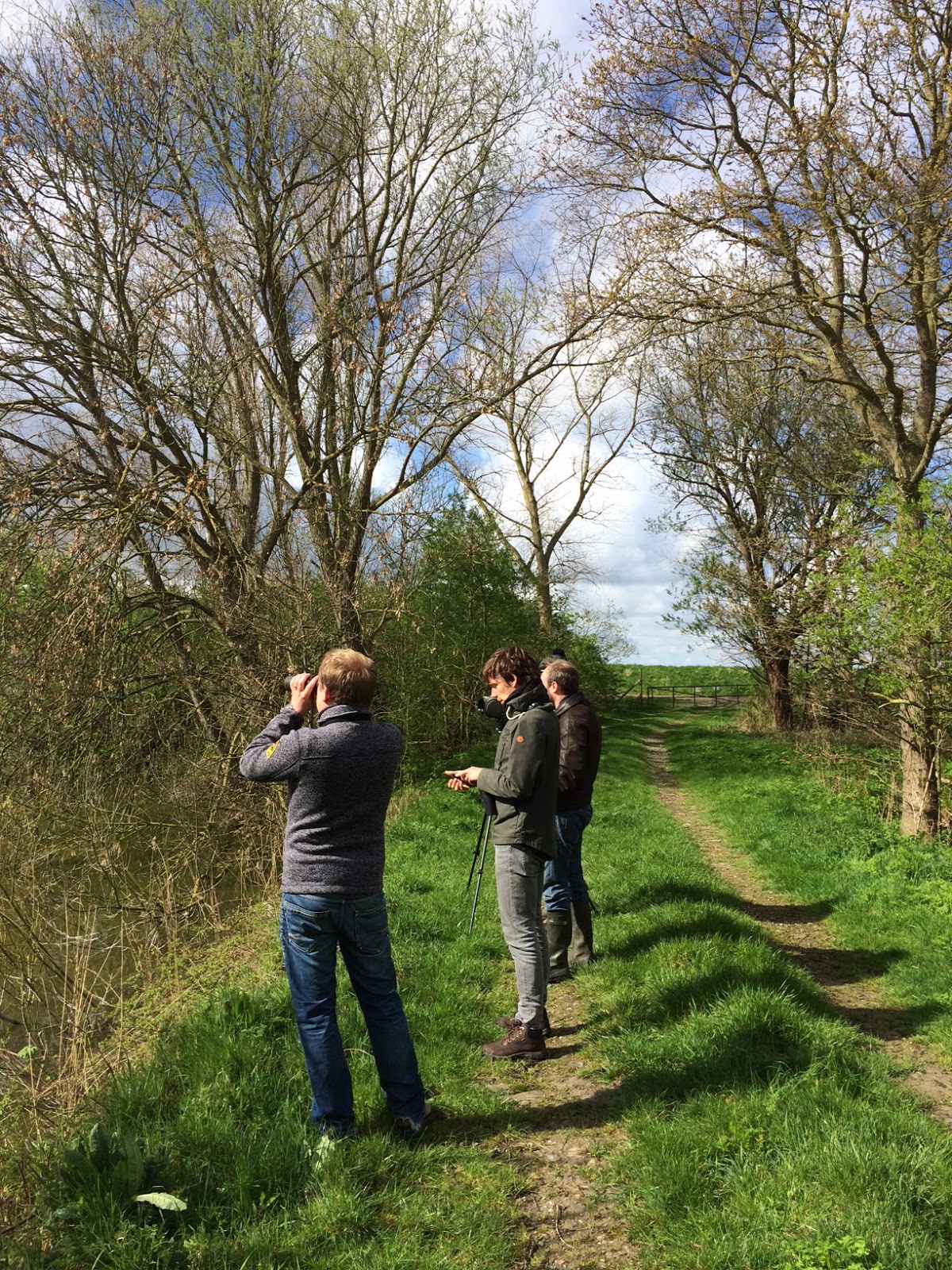
The lads looking at Night Herons near Het Zwin. Note the cold weather gear, even though it's mid April.

Jean and his friends had to head back at lunchtime, after a short and windy visit to the front at Zeebrugge, but with their advice in mind I myself headed up to the beginnings of the Dutch "Delta" between Breskens, which I'd visited before, and the oddly-named "Nummer Een" (literally, "Number One", in Dutch - I've no idea where the name comes from). Here the edge was off the wind and a perfectly-placed hide on top of one of the dykes afforded great views of massed waders and roosting terns and gulls, including surprisingly large numbers of the increasingly inaccurately-named Mediterranean Gull (Larus melanocephalus), looking spick-and-span in their breeding plumage.

The well-appointed and thankfully shower-proof hide at Nummer Een

This whole area along the coast can be fantastic at this time of year - any time between mid-April and the end of May, basically - and if I'd had the time, the sense and the inclination I would have been back over the subsequent couple of weekends to fill in what I missed this time; Bluethroat (Luscinia svecica), for instance, which breeds in good numbers around here. But I didn't, so I missed them, and writing this towards the end of September I can say with some confidence that this is one of a few species that I will certainly now not see this year, as they don't winter in significant numbers in any of the places in Africa that I visit regularly.

I do hope, though, to experience the place in the autumn, for what it has to offer then. And to do so again this coming winter. I made no sorties to the coast at all in the first couple of months of this year, so I missed the mass of grey geese and any chance of Whooper Swans (Cygnus cygnus) and Bewick's Swans (Cygnus columbianus bewickii). That's for the coming period.

Looking across the delta at Nummer Een

Friday, January 02, 2015

Kicking off the New Year - Het Zwin

Belgium, it must be said, is not really a birder's paradise, and Brussels in particular is caught in limbo between the contrasting interests of the coast on the one hand, and the Ardennes on the other. So, although there are some reasonable forest and valley lake sites not far from the city, if you want a more complete day's birding, you'll be spending a few hours in the car and/or staying the night somewhere else.

I haven't really started exploring the Ardennes yet, though I'm looking forward to doing so, hopefully in the early Spring for the Black Grouse (Lyrurus tetrix) lek. The coast I'm more familiar with, and it's here that I came yesterday for my first day's birding of the New Year. I default to a tried and tested location; Het Zwin, at the northernmost point of the Belgian coast, on the border with Holland. In comparison with many of the larger sites further north in Holland itself, this place is no doubt small beer, but most of the rest of the Belgian coast is so developed that it's considered here to be an oasis of wildness in a long line of concrete. As a consequence it's popular, and not just with birders, so being an early bird pays dividends.

But as noted above, Het Zwin isn't exactly close to Brussels. It's a one hour and 45 minute drive when there's no traffic, and most of that is along the mind-numbingly boring E40 highway. But with the sunrise now about as late as it gets in the year (0845) it wasn't too much effort to make it there for first light, and thankfully almost everyone else seemed to be sleeping off the night before.

Het Zwin - not that close to Brussels, but often worth the trip
There are four principal habitats at Het Zwin - a sandy shoreline with a largeish brackish lagoon draining through a creek at the northern end; some saltmarsh and freshwater flooded polders (the latter now being restored as habitat); some coastal woodland, mainly poplar and planted pines, but again being restored to something more diverse; and finally the scrub and grass duneland immediately behind the beach. With this mix in rather a small area there's a reasonable chance of seeing a good spread of species if your luck is in and the weather's good. I reckon I was pretty lucky yesterday.

Het Zwin - the various habitats

I parked at the northernmost end of the nearby town of Knokke and started first with the beach. I do this every time I visit, because it's popular with dog-walkers and runners, and with the tide coming up I was worried about them frightening away all the birds before I had my chance. The sea was calm and desperately quiet. The only birds I saw on it were a small flock of Wigeon (Mareca penelope) and a few Great Black-backed Gulls (Larus marinus). But the tideline was more productive, with a few clockwork Sanderlings (Calidris alba) and flighty Oystercatchers (Haematopus ostralegus).

The beach - look closely enough and you'll pick out a couple of Sanderlings (Calidris alba)
The beach is protected by a series of stone groynes, which attract roosting shorebirds - a mixed bag of Ruddy Turnstones (Arenaria interpres), Grey Plovers (Pluvialis squatarola), Rock Pipits (Anthus petrosus) and Oystercatchers, but with a scattering of three Purple Sandpipers (Calidris maritima) mixed in. This species was one of my fantasy birds on family holidays on the West Coast of Ireland as a child, though we never saw it there, so catching it always makes me think of my father who I think has never seen one himself. I myself have seen it only once before, also at Het Zwin in 2007 and 2008 so this sighting perked me up. I tried my hand at photographing one of these - with the results you can see below. I reiterate my point of yesterday's post; Digiscoping is a skill, and I'm in the process of acquiring it, in the same way that a newborn baby is in the process of acquiring the skills of speaking and walking.

It's a Purple Sandpiper (Calidris maritima), honestly. 
After scouring a small but unexciting gull flock by the creek I struck off into the silent dunes, on a short walk enlivened by only two birds; a skulking Robin (Erithacus rubecula) and an explosive, briefly-viewed Merlin (Falco columbarius), which bombed low over the dunes like a Spitfire and scattered Turnstones and Dunlins (Calidris alpina) in every direction on the far side of the ridge. Along with Purple Sandpiper this was one of two species I saw today that I'd missed last year - which was my Big Year, in case I'd forgotten to mention it. So, altogether, not a bad start.

After a late breakfast overlooking the quiet lagoon, which added only a solitary Goldeneye (Bucephala clangula) to my list, I walked through the woods towards the freshwater polders. As I sauntered along there was a small tit flock including a couple of Short-toed Treecreepers (Certhia brachydactyla) and two Goldcrests (Regulus regulus) working its way through the poplars. And then, as I emerged, a lovely female Bullfinch (Pyrrhula pyrrhula) - perhaps my favourite passerine - settled nicely in a treetop for me to admire its perfect glossy black cap. I had a superb year for Bullfinches last year so it's pleasant to see this one starting off in the same vein.

A female Bullfinch (Pyrrhula pyrrhula) looking only slightly less dapper than the male. Not my photo, as you'd probably guessed.
The polders were thick with Geese - almost all Greylags (Anser anser) but with a few White-fronts (Anser albifrons) and a large flock of Barnacles (Branta leucopsis) mixed in. And there was good coverage of most of the common smaller wildfowl as well - with only Gadwall (Mareca strepera) making its absence felt. A flock of Swans overhead caused frustration. They had less wing noise than I'd expect from Mute Swans (Cygnus olor) and seemed to have predominantly black bills, but they were behind trees before I could see them properly and I couldn't relocate them. I haven't seen Bewick's Swans (Cygnus columbianus bewickii) since I was in my early teens and would dearly love to see them again. Another bird I didn't see today was Pink-footed Goose (Anser brachyrhynchus), but Het Zwin is normally a reliable location for this species and I saw flocks of hundreds here in November.

Sunlight helps - a fine Shelduck (Tadorna tadorna) at Het Zwin on 1 January
It's also worth checking the flocks of Barnacle Geese in the autumn. I did this - again in November - and was rewarded with a true stunner; a Red-breasted Goose (Branta ruficollis), a few of which migrate through this part of the world with the Barnacles each autumn.


Barnacle Geese (Branta leucopsis) and cows (Bos taurus) - but no Red-breasted Goose (Branta ruficollis) this time...
By the time I'd finished at the polders the world had woken up to the New Year and was walking off its collective hangover, so I packed my kit and walked back to the car for the long drive home, with only a stentorian Wren (Troglodytes troglodytes) singing its heart out like a five gram Pavarotti in the scrub on the way back.

So the new year list begins with a start-up figure of 52 species in the bag already. Not bad, all things considered. But then, on the other hand, my first bird last year was a Hadada Ibis (Bostrychia hagedash) seen over palm trees from our then flat in Nairobi. My first bird this year was a Carrion Crow (Corvus corone corone) seen flying over the E40 Highway near Ghent. We thrive on difference, of course, but I suspect it's not hard to choose which species you'd rather wake up to.

Hadada Ibis (Bostrychia hagedash) vs Carrion Crow (Corvus corone corone): which one would you prefer to wake up to?