Wednesday, September 21, 2016

Spring Part 3 - the Belgian coast and the Dutch delta

It's funny what can get you back on a horse after you've fallen off, metaphorically speaking. I haven't written a blog post since April, and it's not for a lack of material. Quite apart from the trip described below, I've had a sensational Spring break in Hungary, a weekend of birding in Uganda, and a family holiday on Mallorca, all with birds to report. And that's to say nothing of a visit to the Masai Mara in January, which I failed to write up at the time.

So, why the absence? The easy answer is busy-ness, and it's true enough. But the real answer is that, both personally and professionally, I've taken a few knocks over the past few months. When that happens you tend to want to share less of yourself, as a loss of confidence in one area leads to a loss of confidence across the board. But, inevitably, along comes a catalyst that shakes you out of your slough, and there's no predicting what it might be.

In my case it was an unexpected and delightful email from a retired former professor of biology in Canberra. I've never met him, nor, alas, do I ever expect to. I've driven through Canberra once, but there is precious little prospect of my returning there, or of David pitching up in Europe, any time soon. But he had read my blog, specifically the one on Sudan, and found it interesting enough to write to me about it. He himself had worked at the university in Khartoum back in the 1960s and in searching for up-to-date information on the natural history of the city and its surroundings, had stumbled upon my ramblings.

The specifics of his message matter less now than the shattering revelation that anyone actually reads this stuff. That is a less idiotic statement than it sounds. Of course I write a public blog. But I do so semi-anonymously, irregularly and on a relatively esoteric subject. And I've no idea whether or how to advertise what I do write. Under these circumstances having any audience at all is not to be taken for granted. The internet is, after all, a vast, virtual graveyard of unread material written by people who hoped it would project their voice to the world. So, as I wrote to David, receiving his message inspired me to get back into the saddle and start writing again about my random and marginal meanderings between diplomacy and ornithology. It's for myself, above all, but if it's interesting and pleasurable for others, which, apparently, it is - then so much the better for me.

The logical place to start is where I left off, which was preparing eagerly for that rare event in my life, a birding trip in the company of other birders. I had met Jean in Montenegro and taken contact details which allowed for us to arrange for day's birding at an old favourite of mine, Het Zwin, on the northernmost extremity of the Belgian coast.

A Common Tern (Sterna hirundo) near Nummer Een in the Netherlands in April
I was eager in anticipation, and early in arrival at our rendezvous, but the initial signs were not particularly propitious. It was mid-April but a freezing wind was blowing straight in off the sea, and sensible birds - and people - were hunkered down. Spring being what it is, song was in the air - Nightingales (Luscinia megarhynchos), Blackcaps (Sylvia atricapilla), Chiffchaffs (Phylloscopus collybita) and Willow Warblers (Phylloscopus trochilus) - but these songs were being delivered for the most part from deep cover, and I can't say I blame the songsters. It was chilly.

Jean arrived with two friends, Wulf and Peter, and comradeship is warming in itself. After my usual solitary experiences this was the birding equivalent of a night in the pub with the lads, and in these circumstances even a lacklustre day took on a certain quality. And lacklustre, honestly, it was for the most part. I was shocked at my seeming decrepitude when I was physically unable to hear a Grasshopper Warbler (Locustella naevia) until we were almost on top of it (though we still didn't see it). But apart from that the morning was notable only for a trickle of predictable year ticks, with the most notable being Avocet (Recurvirostra avosetta) and Woodlark (Lullula arborea).

Things picked up a bit at lunchtime when we headed inland a little to a few ponds next to a vast second-world bunker complex in search of Belgium's only breeding Black-crowned Night Herons (Nycticorax nycticorax). We found them too, which given the wind and the cold was perhaps not to be expected. And in addition we stumbled upon a small fall of migrating wagtails - mostly nominate Yellow Wagtails (Motacilla flava), but with a few of the predominantly-British flavissima race. The original Yellow Wagtails, these were, for me - the ones I grew up with around Stodmarsh and Sandwich Bay in Kent.
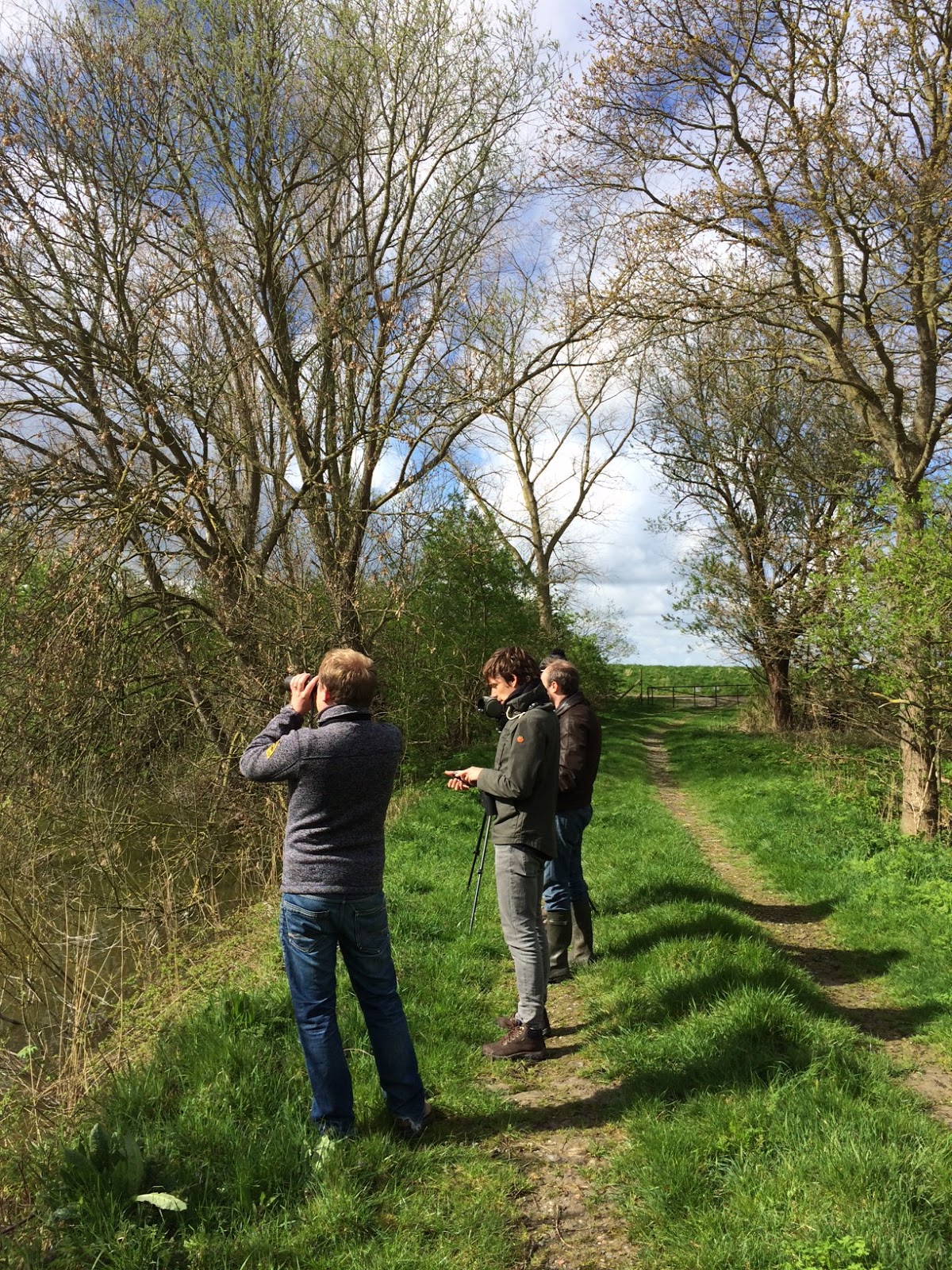
The lads looking at Night Herons near Het Zwin. Note the cold weather gear, even though it's mid April.

Jean and his friends had to head back at lunchtime, after a short and windy visit to the front at Zeebrugge, but with their advice in mind I myself headed up to the beginnings of the Dutch "Delta" between Breskens, which I'd visited before, and the oddly-named "Nummer Een" (literally, "Number One", in Dutch - I've no idea where the name comes from). Here the edge was off the wind and a perfectly-placed hide on top of one of the dykes afforded great views of massed waders and roosting terns and gulls, including surprisingly large numbers of the increasingly inaccurately-named Mediterranean Gull (Larus melanocephalus), looking spick-and-span in their breeding plumage.

The well-appointed and thankfully shower-proof hide at Nummer Een

This whole area along the coast can be fantastic at this time of year - any time between mid-April and the end of May, basically - and if I'd had the time, the sense and the inclination I would have been back over the subsequent couple of weekends to fill in what I missed this time; Bluethroat (Luscinia svecica), for instance, which breeds in good numbers around here. But I didn't, so I missed them, and writing this towards the end of September I can say with some confidence that this is one of a few species that I will certainly now not see this year, as they don't winter in significant numbers in any of the places in Africa that I visit regularly.

I do hope, though, to experience the place in the autumn, for what it has to offer then. And to do so again this coming winter. I made no sorties to the coast at all in the first couple of months of this year, so I missed the mass of grey geese and any chance of Whooper Swans (Cygnus cygnus) and Bewick's Swans (Cygnus columbianus bewickii). That's for the coming period.

Looking across the delta at Nummer Een

Saturday, April 16, 2016

Spring Part 2 - Montenegro

In the past I have been a bore on the subject of the Spring migration in Montenegro, and the following will be no exception. The visit from which I returned at the end of last week did not measure up to the vintage April of 2012, and I’ll go into a couple of the reasons why I think that’s the case, but I still have a smile on my face as I write this, and there barely a single day that didn’t come with a surprise. Given that we were there for ten days, that’s not at all bad.

We arrived on 28 March into Dubrovnik, with my first Spring migrant, a Hoopoe (Upupa epops), making his entrance as we passed between the Croatian and Montenegrin borders at Debeli Brijeg.

The following morning was one of a series of glorious sunny days, and as I took my first walk into Bigovo, it was clear that for birds, too, the Spring was here. Swallows (Hirundo rustica) were already in residence, there were a few Subalpine Warblers  (Sylvia cantillans) displaying, and a Nightingale (Luscinia megarhynchos) was already singing from cover. But there were clearly also birds that were simply passing through; Chiffchaffs (Phylloscopus collybita), for instance, and Blackcaps (Sylvia atricapilla), neither of which, to my knowledge, breeds in the village. And there was a single, flighty, nominate Yellow Wagtail (Motacilla flava) too. But the migrants of the day were Redstarts (Phoenicurus phoenicurus), of which there were several dotted around the village. Interestingly, two of these birds, both females, had clear white edges to their secondaries, creating the effect of a panel on the folded wing. This is a diagnostic feature of the Eastern samamisicus race, which I’d seen for the first time, on a male, in Eritrea last winter, but which surely migrates on a more Easterly path? Interesting. There was a female Black Redstart (Phoenicurus ochruros) on the garden wall, as well, this being presumably a late and more local migrant.

Looking towards the village over the wooded valley in Bigovo

On 30 March the first Short-toed Eagle (Circaetus gallicus) of the year drifted over the house and there was a Whinchat (Saxicola rubetra) in the village, but I had little time to look for other migrants as  I had to pick up my parents from Podgorica. This involved a drive past Skadar Lake, where I picked up a single Dalmatian Pelican (Pelecanus crispus) and a flock of Alpine Swifts (Tachymarptis melba). On the drive back, avoiding major roadworks on the coast, we took the precipitous mountain road over the Lovcen massif and picked up our first House Martins (Delichon urbicum) nesting, as they always do, inside a cave at the top of the road from Kotor to Njegusi.

More migrants made their first appearances on 31 March, with the first Tree Pipits (Anthus trivialis) and Cirl Buntings (Emberiza cirlus) in the village. The latter breed here and these birds seemed paired-up, so are probably here to stay. But at the same time there were lingering signs of winter, too. On 29 March a Robin (Erithacus rubecula) had made its appearance by the causeway from the Church to the village, an area of small fields and orchards with the sea on one side and woodland on the other that seems to be the focal point for migrants here. Robins are birds I have never seen later than the end of March, making them winter visitors here, in my book, and as if to confirm that timetable this Robin put in his last appearance on 31 March, and was not seen again.

The open area of orchards and fields next to the "causeway". This is migrant central for the village in the Spring.

The first day of April took Dad and I to the nearby Tivatska Solila where we picked-up the first Eastern Black-eared Wheatears (Oenanthe hispanica melanoleuca), Northern Wheatears (Oenanthe oenanthe), Spoonbills (Platalea leucorodia), Garganeys (Spatula querquedula), Corn Buntings (Miliaria calandra), Red-rumped Swallows (Hirundo daurica) and Sand Martins  (Riparia riparia) this year. Mirabile dictu, Dad and I also managed to get good views of a singing Nightingale, for the first time, it seemed to me, since I was a boy in Canterbury. A Sardinian Warbler (Sylvia melanocephala) popped-up in the village too, but they seem much less common here than they used to be.

Cuckoos (Cuculus canorus), Whitethroats (Sylvia communis), Lesser Whitethroats (Sylvia curruca) and a Collared Flycatcher (Ficedula albicollis) all put in their first appearances on 2 April. I’m always surprised at how few Lesser Whitethroats we see here, given that the entire European population migrates through the Balkans, but perhaps they pursue a more Easterly and inland route. There was only one seen on this day, and he was the only one I saw throughout our time in Montenegro.

On 3 April it was the turn of Serins (Serinus serinus)– a bird I hadn’t previously seen in the village, but which I had been expecting. More noteworthy for me was an overflying Hooded Crow (Corvus corone cornix). In more than six years I’d never seen this species in the village, though it’s common enough over the ridge in Radanovici. Perhaps its appearance is a sign of encroaching development, and I’ll know that for sure when I see my first Feral Pigeons (Columbia livia var. dom.) for the first time here.

New appearances on 4 April were Pied Flycatcher (Ficedula hypoleuca), a Hawfinch (Coccothraustes coccothraustes) near the causeway, and yet another first for the village – a lone Reed Warbler (Acrocephalus scirpaceus), helpfully perching on a reed. On 6 April the first Scops Owl (Otus scops) started calling mechanically from the scrubby forest around the house.

In the meantime, on 5 April I’d taken myself to Kotor and found most of the usual species in the usual places– Alpine Choughs (Pyrrhocorax graculus) bizarrely in the centre of the town at sea level, and Sombre Tit (Parus lugubris) and dozens of loud Western Rock-nuthatches (Sitta neumayer) behind the city walls on the walking path. I missed a Blue Rock-thrush (Monticola solitarius) this time, though.

Looking down across the Bay of Kotor from behind the walls. All you need is a soundtrack of calling Western Rock-nuthatches to bring this alive.
Throughout all of this time the weather had been an unbroken series of beautiful days, perfect for gardening, which is what we were doing almost all the time. But I was beginning to suspect that this weather, no matter how pleasant, was the explanation for the essentially unspectacular migration we’d so far been experiencing. Alas, my parents had to leave before I could put this theory to the test, because on 8 April, things changed. We woke to haze and a strong southerly wind, with showers beginning later, and exposing the haze as a miasma of Saharan sand, which coated everything in pink dust. It brought with it birds, and many more of them than we’d seen to date, with sizeable flocks of Whinchats, a single Squacco Heron (Ardeola ralloides) and a couple of apparently paired-up Woodchat Shrikes (Lanius senator) at the Tivatska Solila. A juvenile Marsh Harrier (Circus aeruginosus), which had been there when Dad I visited on 1 April, was still there, but he spiralled upward and headed North with the wind behind him as I watched.

9 April, our departure day, confirmed my hunch. It had been cloudy with occasional thunderstorms overnight, driven by the continuing wind from the South, and it was obvious from the start that there were far more birds in the village than had been the case until now, with Tree Pipits, in particular, well into double figures. But the crowning moment of the day, for me, was watching what must have been hundreds of high-flying Alpine Swifts fronting a bedraggled adult male MONTAGU’S HARRIER (Circus pygargus) as it ploughed its way North against the hills, its large black wingtips obvious even in the low light. This, again, was an expected species but it’s the first I’ve seen in the Western Palearctic, all my previous sightings having been in Africa, and it’s the fourth species of Harrier I’ve seen in Bigovo. This means that I’ve seen all four Western Palearctic Harriers in the village. I find that pretty remarkable.

An example of the perfect weather that dominated our visit. Poor us.

The drive to Dubrovnik brought two final migrants; a Turtle Dove (Streptopelia turtur) by the road near the airport, and Spanish Sparrows (Passer hispaniolensis), which breed colonially on the airport building itself, together wth House Sparrows (Passer domesticus), but which had not arrived when we did ten days before.

So, a wonderful experience, but for the most part the migration this year was a stream rather than a river in spate, as I’ve experienced it before. To expand a little on what I said earlier, I suspect the reasons for this were that we were a little early (Dad checked, and our 2012 experience was around 18 April) and that the weather was simply too good – something only a birder could say, surely? My hunch is that with the clear skies and light winds that prevailed until the last couple of days, birds were able to navigate in straight lines at night, and were not dependent on landmarks, as they are when the clouds come down and the wind blows hard. Then, they’re forced to follow the coast and to stop wherever they are for rest and feeding; that place, as often as not, being Bigovo. So, for future reference, and if you’re looking for the migration experience in Montenegro, come around the middle of April, and look out for unsettled weather on southerly winds. Luckily, that combination is common at this time of year. And luckier still, even without it there will still be wonderful show of migrants anyway, as the preceding attests.


There’s a postscript to all this. The birds I’ve mentioned were none of them the most unusual species I saw on this visit. That was that rarest of beasts in Montenegro, another birder. Dad and I spotted this outlandish creature at Tivatska Solila on 1 April and, perhaps more incredibly than seeing him at all, it turned out that he was from Belgium. I was delighted to hear that one of the reasons he’d come, and had done so on the basis of another Belgian birding friend’s recommendation, was for the birds. Montenegro needs, and deserves, much more of this and I’m overjoyed to see it finally coming onto the European birding map. I’m also very happy to have made contact with a potential birding colleague in my current home country, and I’m looking forward to a first outing with him, to the Belgian coast, this very weekend, with a report to follow in due course.

Until next time...

Friday, April 15, 2016

Spring Part 1 - USA

For two years running I’ve been lucky in numerous ways. With respect to birding, the luck I’m referring to on this occasion is with travel, and specifically with Spring work visits to the US.

Last year I was, arguably, luckier than this, with a visit that took place when the warbler migration was well in train, and which included work visits to both Washington, D.C. and New York, as well as a sneaky weekend with my brother in Florida. This year the visit was shorter, earlier and more melancholic, punctuated, as it was, by the terrorist attacks in my current home town of Brussels.

I came at the end of March, arriving in Washington to snow flurries, which quickly gave way to glorious sunshine, heat into the low 20s Celsius and a spectacular display of cherry blossom, of which I completely failed to take any photos. I had only four days in the city, but this included one free morning, and one day entirely free prior to my return to Europe in the evening. I was not about to waste an opportunity like that at this time of year.

The question was, what to do with this time? Having birded in the DC area in both winter and Spring, I had low expectations of my ability to find anything I hadn’t seen before, so the priority was to maximize diversity and see as much as I could in the time available.

For the free morning, I had some places in mind. I knew that I was too early for most of the passerine migrants, and therefore that last year’s hotspot of Rock Creek Park was no likely to be the most productive of locations. So for my free morning I gave that a miss and defaulted instead to Huntley Meadows in Virginia. I had visited this place twice, with Dad, in the late 1990s and had the astonishing luck to see not one, but two species of rail – a King Rail (Rallus elegans) and a Sora Rail  (Porzana carolina)– on the same day and within minutes of each other (to my Dad’s eternal jealousy, he having seen the former but missed the latter). With this sixteen-year-old memory in mind, I headed out full of expectation

It’ was, I have to say, an awful lot smaller than I remember it. Nonetheless, with a good mix of habitats covering woodland, reedbeds and open water, it rose to the occasion. The warm weather put birds in a singing mood and old friends popped up everywhere, including a particular favourite, Carolina Wren (Thryothorus ludovicianus). I was also, not for the first time, struck by the abundance of Woodpeckers here, in comparison to Europe, seeing six species in the course of the morning, including several adult Red-headed Woodpeckers (Melanerpes erythrocephalus), with their smart crimson hoods, which, it later turned out, though I didn’t realize it at the time, were LIFERs for me. So much for not seeing new species. There was a lovely Red-shouldered Hawk (Buteo lineatus) on the ground, as well, and Blue-winged Teal (Spatula discors) on the water.

With a few more good birds around the marsh, and with my first ever glimpse of a Beaver (Castor canadensis) to top it off, this was altogether a good start. But I coulnd’t help but be struck by how much this site has shrunk in comparison to my memory, and started searching for somewhere with more space. I had, as ever, printed out the relevant pages of Paul Milne’s Where to Watch Birds: World Citites, a book that’s now pushing 20 years old and is increasingly not much use in places like Dubai that have changed immeasurably since it was written. For those like Washington, though, whose geography and ornithology have changed much less, this is still a gold mine, and it was on the basis of my study of this book that on the day of my departure I pulled up in my Uber car on my first visit to Jug Bay, on the banks of the Patuxent River in Maryland.

The view across the wide Patuxent River at Jug Bay
The charming Liana at the visitor center made me welcome, proposed a good route for me to walk, expressed amazement at my having reached here with a cab, and gently posited the possibility that it might not be quite so straightforward to get back to Washington. She was right

For me the best surprises of this place were in the forest. I saw most of the six woodpecker species I'd already seen at Huntley Meadows, including the Red-headed, which seems to have had something of an invasion year this year. In addition to these, though, I also managed to bag my first ever Yellow-bellied Sapsucker (Sphyrapicus varius), perhaps the last of the woodpecker species I could reasonably expect to see in this part of America. But I had great views too of a bird I’d only every glimpsed before – Hermit Thrush (Catharus guttatus), which seemed to be two-a-penny here . And despite the wind and a chill breeze there were more signs of migration than I’d seen at Huntley Meadows, with a few soon-to-be-ubiquitous Yellow-rumped Warblers (Dendroica coronata) in the trees.  

Walking along the waterfront came another surprise, and another LIFER – a female Black Scoter (Melanitta americana) riding the waves on the river. There were signs of migration here too, with a few Bonaparte's Gulls (Larus philadelphia) among the Ring-billed Gulls (Larus delawarensis) and American Herring Gulls (Larus smithsonianus). There were American Black Ducks (Anas rubripes) too, which had eluded me at Huntley Meadows, and a single identifiable wader – a Greater Yellowlegs (Tringa melanoleuca), seen from one of the hides (blinds) near the water.

The small area of farmland was a hive of activity as well, with Tree Swallows (Tachycineta bicolor) flitting around and small flocks of Dark-eyed Juncos (Junco hyemalis) and Eastern Towhees (Pipilo erythrophthalmus). I missed the Barn Owls (Tyto alba) though, which apparently nest in boxes on the barns here.

One of the inlets, leading to a Beaver dam, at Jug Bay.
This is a five star destination, as far as I’m concerned, and it’s one I’ll definitely be back to on future visits. For a start, it’s big, and it has big habitats; large reedbeds, long stretches of open water, a modicum of farmland, and significant, contiguous stands of variable forest. Oh, and if you’ve never seen an Osprey (Pandion haliaetus) or a Bald Eagle (Haliaeetus leucocephalus), this is the place to be. They are countless here, and it’s not often you can say that.

Coming again I’d give this place a full day, to do it justice, and I’d bring a ‘scope too, because the lines of sight, particularly across the marsh, can be long. I missed a few waders as a result of not having mine with me. Above all, though, this is a friendly, well-maintained place, with well-informed and enthusiastic staff who maintain the site with maximal consideration for the sometimes competing demands of conservation and accessibility.

It is, though, not that easy to get to or from without your own transport. Thank God Liana was there to help me get a taxi or I might still be there, and would have missed the Spring migration in Montenegro. Many, many thanks, Liana. And more on Spring in Montenegro in a day or two.


Helsinki - birdsong in the bogs

A very short post which I’m writing in Helsinki Airport. Here, birdsong is played as background noise in the lavatories. What a wonderful innovation, and good for testing your knowledge, too. I did pooly, it must be said, recognizing only a Robin (Erithacus rubecula) and failing utterly to have any sense of what the other two species I heard were. Both were passerines, but beyond that I'm clueless.


This was such a short and intense visit (only the morning and lunch) that I hadn’t bothered bringing my binoculars, and I particularly love it when recognizable unexpected species pitch up in these circumstances. On the drive to the airport there was a small flock of Barnacle Geese (Branta leucopsis) by a stretch of water near the harbor and a pair of Fieldfares (Turdus pilaris) in some trees. Both of these (remarkably, in the latter case) were my first for the year. Nice.

Helsinki in the sun today at lunchtime.